
The recent decision by the government Inspector to reject Berkeley Homes’ proposals for the Aylesham Centre provoked much criticism from pro-development quarters, with the local Aylesham Community Action (ACA) campaign often cast as NIMBYs, denying people the opportunity of a new home, because of misguided heritage concerns [^1].
The Inquiry Inspector did indeed reject the application on heritage grounds. Hashi Mohamed the ACA’s barrister at the Inquiry has provided a measured commentary of the decision, decrying ‘hysterical rhetoric’ and pointing out that heritage goes beyond buildings, encompassing ‘the people, the culture and history of Peckham’. He encourages people to read the full decision [^2].
One other key issue was the dire lack of affordable housing in Berkeley’s proposals - just 77 homes out of 867. Regrettably the Inspector did not think this was a ground for rejecting the application, saying that even if the scheme offered 35% affordable housing he would not have granted the scheme planning permission (which says something about how poor he considered the design to be) [^3].
Affordable housing depends on a scheme’s viability and it is worth replaying the evidence presented at the Planning Inquiry by ACA's expert witness, because it demonstrates that viability is not set in stone, contrary to what many believe, but is a variable, determined by assumptions, projections and judgement.
ACA’s viability evidence also demonstrates the serious thought and effort they put into the Inquiry, something that is absent from much of the commentary that followed the Inquiry decision.
The housing picture in Peckham
The ACA evidence sets the scene by describing Peckham and Southwark’s particular need for affordable housing. Using middle-value homes as a measure, they show that market housing is more expensive in Southwark, when matched against income, than in most other parts of the UK. A middle-priced home in England has a value just over eight times a median income, whereas in Southwark it is well over twelve times median income. Put another way, a middle-income earner has to pay proportionately more to buy a home in Southwark than they would have to pay almost anywhere else.
Unsurprisingly, this is reflected in relatively low levels of owner-occupation - less than 30% of housing stock in Southwark, 32% in Peckham, compared to 60% nationally. Correspondingly, the social rent levels are relatively high – 44% of housing in Peckham, compared to 23% across London and 17% nationally. The remaining 24% of Peckham households are in private accommodation, where they are likely to be paying at least 41% of their gross income on housing costs.
ACA accurately conclude that ‘The role played by affordable housing is, accordingly, far greater here than elsewhere’ [^4].
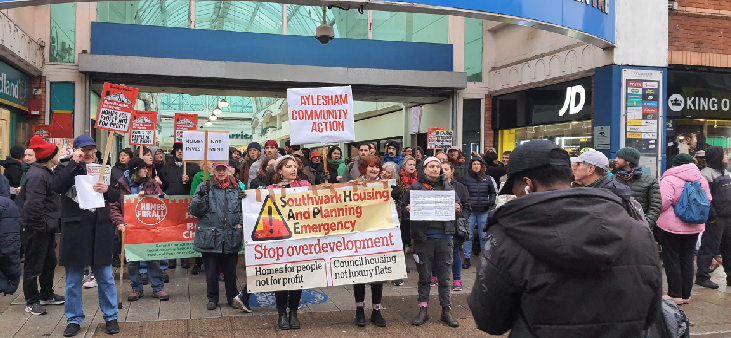
ACA – new homes yes, gentrification no
Having spelt out the importance of affordable housing in Peckham, ACA then lays out the shortcomings of Berkeley’s proposals. They first show how even the local plan requirement of 35% affordable housing over-delivers free-market housing and under-delivers affordable housing, when measured against housing need; anything less than 35% obviously creates a greater imbalance [^5].
ACA then address the ‘half-a-loaf is better than no loaf’ argument by pointing out that the simple loss of affordable housing is not the whole story. The development would overwhelmingly be comprised of smaller homes, attractive to first-time buyers and investors, but unaffordable to most local households - who are therefore likely to displaced by wealthier ones (a visit to Elephant Park, formerly the Heygate estate, shows how this works) [^6].
The viability of the Aylesham development
ACA also take up a point many critics of the decision have landed on - that Southwark Council agreed with Berkeley that a scheme which included affordable housing was not viable .
This is true - Southwark did agree that the scheme was unviable. But 'unviable' does not mean 'unprofitable' and there was disagreement about how much profit the scheme would make, even with a viability deficit. Berkeley said it would be a £39.4m profit (on a deficit of £67.3m), while Southwark said it would be a much higher £84.4m (on a deficit of £41.4m)[^7].
Also, in common with all planning authorities, Southwark does not conduct its own viability assessments of planning applications, for the Aylesham or anywhere else. Instead, it appraises the financial assessments that developers provide, which are ‘undertaken in the context of specific choices made by a developer, beyond the control of a Council and the local community’, as ACA pointed out [^8].
And one of the ‘specific choices’ made by Berkeley was to take on a site with a Morrisons supermarket, which has to be re-provided in any redevelopment, both as a requirement of the local plan and as a lease obligation.
Notwithstanding this unavoidable cost Berkeley initially offered 35% affordable housing, only to later specify the supermarket replacement cost (which they knew about all along) as the one site-specific reason for reducing the affordable housing offer to 12%.
ACA note in their evidence that replacing the supermarket will cost £44m, an exceptional sum when compared to its current value of £13m. The supermarket will also come with a very large basement car-park, much larger than that for the Camberwell Morrisons and in an area with the highest public transport rating [^9].
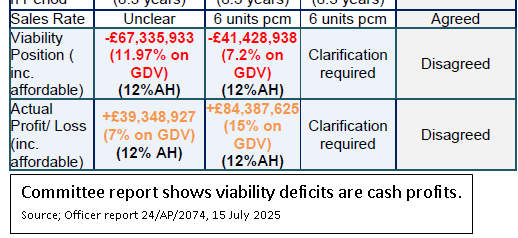
More viability....
ACA tackle aspects of the viability of the scheme in the same deliberate, critical fashion. They acknowledge that when a viability assessment justifies less than 35% affordable housing, the development may be considered policy compliant. But they add that, as well as viability depending upon ‘specific choices made by a developer’, the weight given to the assessment is a matter for the Inspector to decide and put three factors to him for reducing that weight.
The first of these was that Berkeley’s assessment that the scheme’s profit would be £67m short of their target seemed to be at odds with their assertion, made at the July planning meeting, that the scheme was deliverable.
ACA add that small changes to viability inputs on such a large scheme can transform outcomes; ACA suggest that these, taken with Berkeley's evident eagerness to proceed, could at least mean the scheme was viable.
The second factor is that the assessment generates a higher return for the landowner than normally permitted by viability guidance, once the value of the new Morrisons store is taken into account. ACA believe that the options for reducing this critical cost, including its expensive basement parking, had not been fully explored.
The third factor favouring reducing the weight is simply that ‘something is seriously amiss’ if a central London site such as the Aylesham cannot deliver more than 12% affordable housing [^10].
Finally, ACA lament the loss of the Community Land Trust housing, on top of the lost affordable housing. They observe that the Aylesham is the only site in the local plan that has CLT provision and that the shared-ownership affordable housing preferred by Berkeley no longer acts as a ‘leg-up’ onto the housing market for young, working households [^11].
Affordable housing falls, profits rise….
ACA’s evidence also demonstrates how the scheme might be made viable. Looking just at the housing element of the development, ACA shows profit increasing from £77m, with 35% affordable housing, to £101.6m, with 12% which prompts the comment that ‘reducing the public benefit of the scheme by cutting the level of affordable housing from 35% to 12% allows Berkeley to enhance their allowable profit by a third’.
ACA also note that increasing profit this way, thus making the scheme less viable, while reducing affordable housing, ostensibly to make it more viable, is a ‘little perverse’ (NB profit is treated as a cost in viability assessments) [^12]. ACA endorse the GLA’s suggestion that the 20% GDV profit Berkeley awards itself be reduced to 17.5%, if viability is the aim.
The ACA evidence also addresses the £60m cost of finance, again suggesting alternative debt arrangements to aid the viability of the scheme.
ACA finally make some tentative suggestions as to how build costs might be reduced and conclude with their own indicative appraisal, showing how the development could be made viable [^13].
Berkeley replies….
Berkeley replied to ACA’s arguments in a rebuttal statement. They take issue with ACA for taking ‘a second bite of the cherry’, having already acknowledged that the scheme had be through the full viability process. They state that the level of affordable housing had been ‘rigorously tested in an extremely challenging economic climate’ on an ‘objective basis’ as required by the National Planning Policy Framework (NPPF) and according to professional standards.
Berkeley said that the 20% GDV ‘developer return’ is allowable under the NPPF, agreed with the Council and is justifiable because development risk is higher than at any other time in the author’s 25 years’ experience in the industry.
The cost of finance was also calculated according to professional guidance and after a detailed itemised break-down; it was agreed with Southwark Council as were the build costs. Any savings or cost increases would in any event be picked up by viability review.
Berkeley also justifies dropping the Community Land Trust, and favouring intermediate homes instead, as the best way of optimising the affordable housing provision [^14].
The Inspector decides....
The Inspector’s eighteen-page decision identifies four main issues – the scale of the development and its impact on the townscape, the loss of retail floorspace and how that would affect the vitality of the town centre, the affordable housing provision and how much weight give each of these factors, alongside the public benefits of the scheme, in his decision-making [^15].
The Inspector decided that Berkeley’s scheme would not cause any loss of vitality to the town centre. While he noted that 93% of households had an income that required social or intermediate housing, he nonetheless also concluded that the affordable housing was a benefit, even if only 12% of the total [^16].
His final decision, though, turned on whether these factors, along with the other public benefits, including 867 new homes, outweighed the harm caused to the townscape by the scheme. On this he was emphatic, saying ‘… the direct benefits arising from the development comparative to harm to the RLPCA [Rye Lane Peckham Conservation Area]….and to the townscape give me insufficient reasons to allow the appeal’. He adds, for good measure, ‘For clarity, even with 35% affordable housing as initially proposed in the planning application process and accepting a worsening housing land supply position…… I would still have found that the level of harm in this case would not be overridden’. He therefore rejects Berkeley’s appeal and their proposals for the Aylesham Centre [^17].
What we say....
Much of the criticism of the Aylesham decision is uninformed and bristles with indignation. The idea that Peckham has a history and a heritage is seen in some quarters as a bit of joke and, anyhow, not something that should be allowed to get it the way of a big developer like Berkeley. If Berkeley’s new homes are too expensive for local people that’s just too bad – ‘viability’ dictates that affordable housing is no longer on the menu.
But this is all wrong. Peckham does have history and heritage, and the viability of the development is not immutable, as ACA’s reasoned and researched Inquiry evidence demonstrates [^18].
Berkeley’s homes are too expensive for local people because Berkeley chooses to build them that way, not because of viability. Berkeley knew well enough, for instance, that the site included Morrison’s supermarket and they also set their own profit levels, key elements of any viability calculation – the people of Peckham and Southwark should not now have to sacrifice their own housing opportunities to make that equation work for them.
Berkeley’s Aylesham proposals have been rejected twice, by Southwark Council and by the government Inspector. Berkeley should take the hint and come back with something that meets the housing and other needs of local people. If they cannot do that and still make a reasonable profit then they are not much use as developers.
Footnotes
[^1] This is a selection of the many reports and comments on the decision, in no particular order and covering different shades of opinion - Inside Housing, Homes for All, Southwark News, My London, Evening Standard, (and here), MSN, Architects' Journal, East Dulwich Forum, CAPX, Housing Today, Southwark Council, Vicky Spratt, Robert Bevan (@authenticfutures), GB News, Looking For Growth, Miatta Fahnbulleh MP, Southwark Labour. There were also articles by the FT, Daily Telegraph, the Times, and the Spectator, all behind paywalls.
ACA took part in the Inquiry as a Rule 6, or interested, party. They raised £58,571 to be legally represented by barrister, Hashi Mohamed, of Landmark Chambers and solicitor Jed Holloway, of the Southwark Law Centre. Southwark Council appeared as the local planning authority. Both the ACA and Southwark Council argued against Berkeley's application for a planning permission.
[^2] Mr Mohamed also recommended visiting the Inquiry website. Unfortunately this is no longer online. Planning inquiry documents are held by Southwark Council.
[^3] Appeal decision Ref: APP/A5840/W/25/3366760, Para 110;
[^4] BVA Associates, on behalf of ACA, Rule 6 Party, Proof of evidence (PoE) on affordable housing and viability for planning appeal inquiry relating to development at The Aylesham Centre, Sept 2026, Paras 1.4,1.5; 3.0 The Housing Situation in Southwark and Peckham.
[^5] BVA Associates, PoE on affordable housing and viability, para 1.6 -1.9. Para 1.9 states - 'Built out on that basis, the plan would deliver 1,531 open market homes each year (about 180% of the requirement) and 824 affordable homes (40% of the requirement)'.
[^6] BVA Associates, PoE, paras 1.12-1.15
[^7] Officer report, 15 July 2025, para 313. See also our previous Aylesham blogpost.
[^8] BVA Associates, PoE, para 1.17
[^9] BVA Associates, PoE, para 5.19-5.58, for a detailed examination of the cost of replacing Morrisons. The Aylesham site has a Public Transport Accessibility Level (PTAL) rating of 6b, Officer report, 15 July 2025, para 22.
[^10] BVA Associates, PoE, paras 1.16-1.27.
[^11] BVA Associates, PoE, paras 1.28-1.37
[^12] Profit is counted as a cost in the approved method of establishing a scheme's viability. In this sense it is little different to other costs, including the cost of affordable housing, hence the ACA comment.
[^13] BVA Associates, PoE, Appendices, Annexes A and B. Unfortunately the Appendices are no longer online, but all planning inquiry documents are held by Southwark Council.
[^14] DS2, on behalf of Berkeley Homes, Rebuttal Proof of Evidence, Viability, Oct 2025, Section 4 Rule 6 Party Viability Evidence. Unfortunately the rebuttal is no longer online, but all planning inquiry documents are held by Southwark Council.
[^15] Appeal decision, para 5
[^16] Appeal decision, paras 68,104
[^17] Appeal decision, paras 108, 110, 112
[^18] Much of the credit for establishing the RLPCA belongs to the Peckham Society and Peckham Vision. Peckham Heritage has also been a force and has recently published 'Peckham's Heritage; Past, Present and Future'.
For a wider consideration of the Aylesham Centre scheme, as an example of the impact of viability on major housing developments, see “A broken model”: The viability loophole and its impact on affordable housing by Peter Apps.