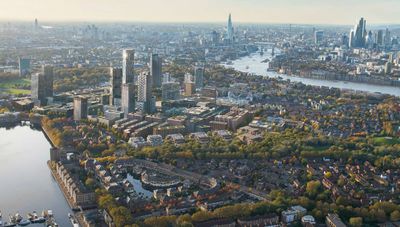
London Mayor Sadiq Khan has approved the reduction of affordable housing on the giant Canada Water development, cutting it from 35% to 9%. Reviews of the viability of the scheme hold out the possibility of additional affordable housing, but with no guarantees [^1]. The application for the reduction, from developer British Land (BL), was approved by Deputy Mayor Jules Pipe (acting on the Mayor's behalf) on 27 March, after he heard representations from GLA and Southwark Council officers, objectors and British Land.
Southwark Council had granted the original planning permission to BL in 2019/20, for 2,000 to 4,000 new homes, plus other uses and amenities. This permission required 35% affordable housing (25% social rented and 10% intermediate housing), which might have risen to 40%, with additional intermediate housing, if there were viability improvements**.** At the beginning of last year BL made a s73 application to Southwark, to reduce the affordable housing requirement to 3% (while also increasing the height and density of the scheme). In November 2025, BL referred the s73 application to the Mayor, taking the decision out of Southwark's hands [^2].
How many family homes have we lost?
Working out just how many affordable and family homes have been lost by the Mayor's decision is not straightforward, because we do not know how many homes will be built - the overall size of the development can be anything from 2,000 to 4,184 residential units [^3].
BL's amended application also goes beyond reducing the number of affordable homes, by also adding to the types of housing that can be provided. Homes can either be 'conventional', as in self-contained homes, or 'non-conventional', with co-living housing joining the already permitted student accommodation. Co-living is a new type of shared-living accommodation, similar to student housing, but aimed at professional singles and couples. If the maximum allowed amount of student and co-living accommodation is built it will account for nearly 20% of the total residential floorspace [^4]. Assisted living accommodation and key worker housing is also permitted [^5].
In addition, the mix of dwelling size has been further restricted to favour smaller homes, to the detriment of family housing (three-bed plus). The original permission already allowed BL four 'family housing free' zones, with no obligation to build three, four or five bedrooms in Zones B,C,D,F. The amended permission goes further, requiring no family housing across the entire site, other than as a proportion of affordable housing (of which there will be very little, as we show below) [^6].
This major departure from Southwark's planning policy (which requires at least 20% family homes) is dismissed in a half-sentence by the GLA, who say it is justified because BL 'has identified insufficient demand' [^7].
Any balance in the mix of dwelling sizes is also tipped firmly towards smaller housing by BL retaining the original permission for 10% studio flats; all these must be free-market, but will, nonetheless, also be twice the Southwark Plan limit of 5% [^8].
How many affordable homes have we lost?
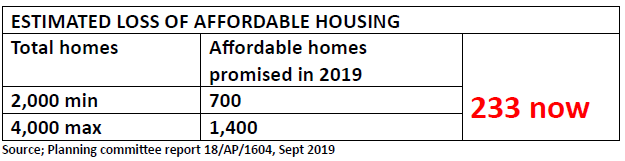
While BL have been given plenty of latitude in choosing what kind of residential housing they can build, their affordable housing obligations have been precisely limited. The new permission requires just 233 social rented homes - the 79 already built on Plot K1 (Roberts Close), four units not delivered on Plot A1 and 150 promised as part of the next tranche of 1,000 homes, to be built on Zone L [^9]. The small possibility of further affordable housing of any kind will then depend on viability reviews, mid-way through and at the end of the scheme.
Not knowing precisely how many homes will be built, of what type and size, and how many habitable rooms there will be, means we cannot say exactly how many we have lost by the reduction of the affordable housing percentage [^10]. We do know that the original 2019 planning committee report estimated that Canada Water would provide around 700 affordable homes (500 social rent, 200 intermediate) if the scheme was built to its minimum limit of 2,000 units. Making an estimate using the maximum number of 4,000 units results in about 1,400 affordable homes, of which 1,000 would be social rent and 400 intermediate housing [^11].
We can also use BL's own figures. Based on a total of around 3,000 homes, BL said that 'If a viable route to 35% affordable homes were identified, this would represent a total of 900 social rent homes and 400 intermediate homes.....' [^12].
Deducting the 233 social rented homes under the new permission from the promised social rent numbers gives various losses, depending on the total number of homes built - 267 lost, if 2,000 homes in total built; 667 lost, if 3,000 homes built, 767 lost if 4,000 built [^13]. The actual loss will probably be at the higher end of the scale, given that BL are likely to build to the maximum number of homes allowed.
More floorspace, 64 extra storeys, but not many more homes
While the affordable housing has plummeted, the size, height and density of the development has increased. The scheme is divided into 13 zones, ten of the zones will have housing and BL have been permitted to increase the individual floorspaces for seven of these. The cumulative floorspace for all the zones now exceeds that of the limit for the whole scheme (which has also increased), though BL will not be allowed to build beyond the whole scheme limit. Separate from the increases in floorspace, the zonal caps on specific land usage, ie the limits to the types of buildings allowed in each zone, has been removed. By these arrangements BL are afforded '.. flexibility in the quantum of development that comes forward... in each Zone' [^14].
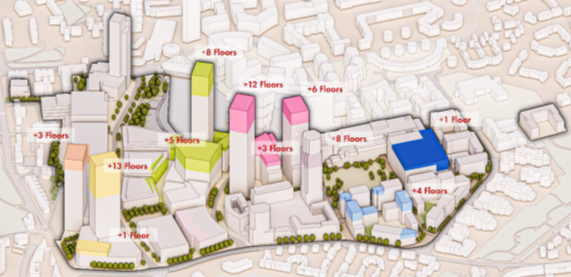
These changes come in the shape of an extraordinary total of 64 extra storeys, across eleven residential blocks, increasing the residential floorspace by over 40%. Seven of the blocks will be over 35 storeys, with three over 45 storeys, the tallest being 49 storeys [^15].
The residential floorspace itself makes up about 60% of the total floorspace. Most of the gain in floorspace is being used to accommodate a second staircase, as required by new building-safety regulations, post Grenfell, so there will only be a relatively small increase in housing, of about 189 units [^16].
Local councillors and Southwark Council object
Several objectors appeared to speak against BL's s73 application. The common theme was how Canada Water represented an opportunity to address local needs that would be lost, if the Mayor approved BL's proposals.
Local councillors, Cllrs Kath Whittam, Stephanie Cryan and Bethan Roberts spoke powerfully, drawing from their constituent's experiences. They welcomed the social rented housing on Robert's Close, but otherwise lamented the lack of amenities provided so far from phase one of the scheme; they reminded the Deputy Mayor of the crying need for family and affordable housing. Local resident, Michael Robertson spoke of the local cultural impact of the development. Jed Holloway, of Southwark Law Centre, and Jerry Flynn, of the 35% Campaign, challenged the great weight the GLA had given to BL's viability assessment, against the neglible weight given for the harm caused through the lack of affordable housing.
Southwark Council also objected to the application. They had approved the original application, after judging that the benefits of its affordable housing outweighed any harm caused to strategically important views of London by the scheme's size and height. Now that the scheme had grown bigger and the affordable housing smaller, Southwark had come to different conclusion and said that, on planning balance, officers would have recommended that the application be rejected.
The GLA had also considered the harm to London's views, giving it 'considerable importance and weight'. Contrary to Southwark Council, though, the GLA concluded that the public benefits of the scheme '...would clearly and convincingly outweigh the heritage harm', despite the drop in affordable housing [^17].
What we say...
Southwark Council gave British Land planning permission for what is its biggest ever development in large part because it promised to provide hundreds of affordable and family homes. BL have now broken that promise in cynical fashion.
BL's justification for going back on its word is twofold - part site-specific and part relating to the wider economic headwinds, concluding with the usual developer complaint that what was promised is no longer 'viable'. The site itself is constrained, BL say, because it must not impinge on important London views, limiting building heights and size; they also have a lot of upfront infrastructure costs, without the prospect of any immediate returns. While this may all be true, it was equally so back in 2019, when BL nonetheless felt able to promise 35% affordable housing (when it needed to get planning permission).
But BL say what was possible in 2019 is not possible now, because building safety regulations are so much more onerous and the economic situation is worse than it has ever been [^18]. Again, this may be true, but new safety regulations, and the second staircase requirement in particular, came about because of a sector wide failure to build homes that were safe for people to live in, demonstrated by the calamitous Grenfell fire. It is a measure of BL's true commitment to building places that are 'the most sustainable to work, live and visit' (as their website boasts) that they are not only complaining about new regulations, but use them as a ready reason to build less affordable and family housing.
...BL give the game away...
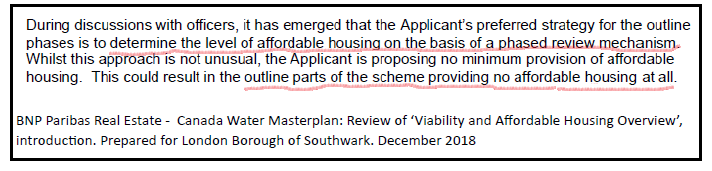
And in fact BL have never really wanted to commit to delivering either 35%, or any a fixed amount of affordable housing. Real estate consultant BNP Paribas appraised BL's viability reviews on behalf of Southwark Council, and said of a 2018 version that '..the Applicant's preferred strategy for the outline phases is to determine the level of affordable housing on the basis of a phased review mechanism'. So BL's position now, in 2026, is much as it was in 2018, before the introduction of new building safety regulations and despite the more favourable economic circumstances of that time [^19].
BNPP said then that BL's approach '....could result in the outline parts of the scheme providing no affordable housing at all' and cautioned the Council about '..their lack of ability to negotiate the level of affordable housing at the review stages, as the review structure is likely to be formulaic'. Southwark evidently took heed of BNPP's advice and only gave the original planning permission on the promise of 35% affordable housing. Now, though, in 2026, after the Mayor's decision, BL have their 2018 'preferred strategy' back in place and the only increase in affordable housing beyond 9% depends upon viability reviews [^20].
...but strengthen their grip...
There is little hope that we will see much improvement in affordable housing from these reviews. Apart from leaving Southwark (and the Mayor) with little negotiating power, their formulaic nature, as BNPP warned, strictly limits the possibility of additional affordable and family housing.
First, the reviews will only cover the residential element of the development, so any uplift in the value and profit of the approximately 40% non-residential part of the scheme will not be captured. Secondly, the amount of additional affordable housing is capped at 40% - just 5% more than the minimum required by the Southwark Plan, and 10% below both the Mayor's and Southwark's strategic affordable housing target [^21].
Thirdly, Southwark will only get 60% of any surplus for additional affordable housing, with 40% remaining with BL. Fourth, there will be no surplus until BL hit their profit target. The target under the original planning permission was 16% GDV (Gross Development Value), now amended to 15% IRR (Internal Rate of Return). This appears lower at first glance, but a close look at the figures shows that this is probably not so, and that BL will be able to make at least £1bn in profit before they are required to provide for a single extra affordable home [^22].
It is also very unlikely that BL will build any additional affordable housing without the incentive of public funding. They are already receiving £51.3m for the 233 homes pledged - an average of £220k per home - and will no doubt want as least as much for anything more [^23].
The Mayor has made the wrong decision
It is not surprising that BL have responded to the current bad economic conditions and the costs of new safety regulations, by building bigger and higher, and shedding affordable and family housing. The fault lies with the Mayor for accepting that the circumstances of the moment, however bad they are, justify these reductions. Canada Water is a multi-phase scheme that is not due to be completed, optimistically, until 2033 [^24]. Any reduction in affordable housing, if needed at all, should be short term. That is the aim of the Mayor's 'emergency measures', which have just cut the affordable housing requirement to 20% for two years. This is supposed to unlock 'stalled schemes', like Canada Water, but if it does so, the price will be a permanent loss of affordable and family housing [^25].
BL are also able to get an even greater affordable housing cut, to 9%, by taking full advantage of viability assessments. These have also left Southwark with little realistic chance of reaping the benefit of any economic improvement, by way of viability reviews.
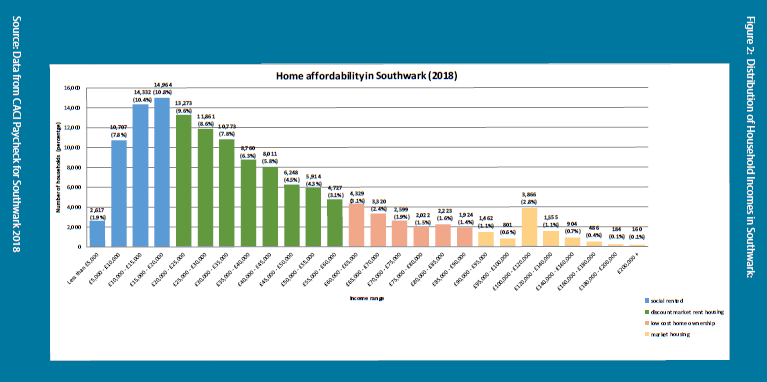
The impact of these losses is made stark by the fact that 93% of Southwark households are eligible for affordable housing, or, put another way, only 7% of households can fully afford free-market housing, which is just about all we are getting from BL on Canada Water [^26].
All this means Southwark Council must not give up the fight for more affordable and family housing. BL's amendment is to the outline part of a hybrid planning permission and there will now be several more detailed planning applications, with the first including the remaining 150 or so social rented homes. Southwark Council must make it clear that this is not enough and that it expects the 35% affordable housing BL promised back in 2019.
---------------------------------------------------------------------------------------------------------------------
Footnotes
Unless stated otherwise all paragraph references are to GLA Stage 3 report (GLA/2025/1006/S3, Southwark ref 25/AP/0242, 27 March 2026). Most of the planning documents can be found via Southwark's Planning Register, using the planning reference numbers.
[^1] Para 210.
[^2] For original permission details see Planning committee report, Chapter 9, Housing and Viability, pg 5, 18/AP/1604, 25 & 30 Sept 2019. For proposed 3% affordble housing figure see GLA Stage 3 report, para 196-198
[^4] Para 29. Total residential 472,000sqm, including co-living up to 50,000sqm maximum floorspace, according to footnote. Maximum student floorspace of 50,300sqm, giving total co-living/student floorspace of 100,300sm divided by total residential floorspace of 472,000sqm, giving 21.25%.
BL pitched unconventional housing as being affordable housing in their original application, in a list including 'Southwark target rent', but also eight other different 'affordable' tenures, including 'Retirement rent', 'Shared accommodation' and 'Retired shared-equity'. See Quod, Financial Viability Assessment, Clarification Note 3, Fig 1, Nov 2018.
[^5] Para 183, 207.
[^6] The development is divided into thirteen development zones, ten of which have housing (including completed Zone K). For Housing Mix under the original permission see Canada Water 18/AP/1604, s106, Annex 15. The amended application restricting family housing to affordable tenures will apply to all zones; see Canada Water Draft s106 Deed of Variation, 25/AP/0242, Annex 2.
[^7] See the Southwark Plan 2022, P2 New family homes,1.2. for the family homes requirement and GLA Stage 3 report Para 27, for lack of demand for family housing.
Contrary to the GLA and BL's opinion there is a high need for family housing in the borough, as the Southwark Plan, drawing on the Strategic Housing Market Assessment, explains - 'The SHMA shows that the highest need in social rented and homes of up to 50% of a low market rent is two, three and four bedroom units for which there is a shortfall of 659 units'. (P2, New family homes, Reasons 1.)
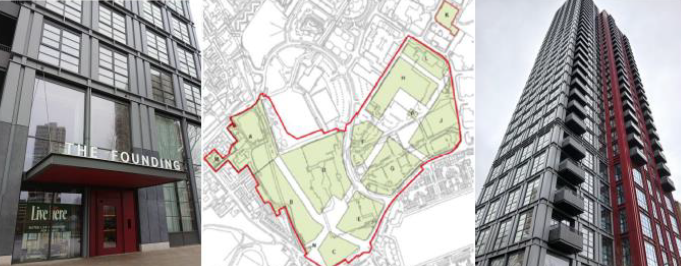
But the GLA and BL are obviously solely concerned with market housing, and here the lack of demand for family homes could be explained by its ultra-high cost - £1.48m for a new 3-bed, with 'Skyline view' (The Founding, Canada Water, accessed 15 April 2026).
[^8] See Canada Water Draft S106 Deed of Variation, 25/AP/0242, Annex 2 for percentage of studio flats. See Southwark Plan 2022, Policy P2, New family homes, 1.7 for studio flat maximum.
[^9] The figures are given in various parts of the GLA Stage 3 report para 2ii - 150 units from next tranche of 1,000 homes; para 10, bullet nine - 79 social rent from Plot K1; para 200 - four social rented units, which were to have been eight intermediate units; para 199 - Zone L to be next phase.
[^10] The amount of affordable housing due is calculated using habitable rooms. This gives a more accurate percentage figure, but results in fewer affordable homes than a calculation based on units, because affordable units tend to be larger, with more habitable rooms per unit than market housing.
[^11] Planning committee report, Chapter 9, Housing and Viability, pg 5, 18/AP/1604, 25 & 30 Sept 2019. The report further says that 'Increases in housing delivery up to around 3,995 new homes would lead to a proportionate increase in affordable homes'.
[^12] Quod, Housing Statement Addendum and Financial Viability Assessment, January 2025, para 2.10.
[^13] We have reported what was claimed at the time, notwithstanding that there is an obvious discrepancy between the increase in social rent of 400 units, in the total rise from 2,000 to 3,000 total units, while there is only a rise of 100 social rent units in the rise from 3,000 to 4,000 total units.
[^14] The total floorspace limit is increased from 656,200sqm to 766,148sqm (16.75%). The cumulative zonal total is 837,400sqm; the zonal total exceeds scheme total (Para 25); removal of zonal use limits (Para 183).
[^15] B3 increases by 3 storeys (to 45 storeys); C1 by one and 13 storeys (to 35) ; D2 by 8 storeys (to 49); D6 by 5 storeys (to 12); F1 by 12 storeys (to 46); F2 by 6 storeys (to 38); F3 by 3 storeys (to 12); G1 by 8 storeys (35); J by 4 storeys (across a multi-block of 6,15,10 storeys); H3 by 1 floor (to 8). Building A1 remains at 35 storeys. GLA Stage 3 report Para 24 image and Housing Statement Addendum and Financial Viability Assessment, January 2025 QUOD, Appendix A, pg 43, 25/AP/0242,
[16] Para 26. The residential floorspace limit is increased from 331,500sqm to 472,600sqm (42.56%). The total floorspace cap is increased to 766,148sqm, making residential 62% of total, if both built to the maximum floorspace allowed.
[^17] Para 390.
[^18] The industry perspective can be found here - London’s Homebuilding Crisis: Why Has Building in London Stalled?.
[^19] BNP Paribas Canada Water Masterplan: Review of Viability and Affordable Housing Overview, Dec 2018, 18/AP/1604. The second staircase requirement was introduced for London in Feb 2023. The new Gateway 1 building regulation was introduced in August 2021. Gateways 2 and 3 came into force on Oct 2023.
[^20] BNP Paribas Canada Water Masterplan: Review of Viability and Affordable Housing Overview, Dec 2018, Introduction, 18/AP/1604. One advantage of BL's preferred strategy for Southwark in 2018 would have been that 100% of any surplus would have gone towards additional affordable housing. This became 60% in the eventual planning permission and remains 60% in the amended permission, with 40% going to BL.
[^21] Southwark Plan 2022, Strategic targets, Providing quality social rented and intermediate homes, bullet 3. London Plan 2021 Policy H4 Delivering affordable housing.
[^22] Para 203, 204 for profit targets. For projected profit see The Base Viability Appraisal annexed to the draft s106 Deed of Variation. This gives a profit of £445.37m, (7.47% GDV; 7.56% IRR) with c9% affordable housing. A BNPP assessment gives profits of £1.061bn (16.14% GDV; 11.13% IRR), for a scheme with c3% affordable housing and £1.062bn (16.17%;11.17%IRR) for one with c6% affordable housing; see BNP Paribas Canada Water Masterplan: Review of Housing Statement Addendum and Financial Viability Assessment, Sept 2025 25/AP/0242.
BL proposed an amended profit target of 17.5% IRR, but the GLA insisted on 15%. See Canada Water Masterplan, Section 73 Application, 25/AP/2402, Draft Heads of Terms, Housing 3rd bullet. Also GLA Stage 3 report para 204.
[^23] Para 393. The Mayor has made two grant awards for affordable housing, one of £7.55m, and a second of £43.75m. Southwark Council has also made a £35m contribution towards the leisure centre. Total contributions amount to £86.3m. See Baseline Viability Appraisal, Additional Revenue. The BL representative at the application hearing gave an approximate construction cost of £500,000 per housing unit, which would mean that over half of the construction costs of the remaining 154 affordable homes are met from the public purse. The construction cost for the Leisure Centre, plus 'Grown Fees' is £9,700,000 (Quod, Housing Statement Addendum and Financial Viability Assessment, January 2025, pg 54, Financial Management Report 22, 25/AP/0242).
[^24] See Planning Statement Addendum, January 2025, DP9, 7.1.2, for completion date of 2033. The development was approved by planning committee in Sept 2019. The s106 agreement, sealing the planning permission, was signed in May 2020. The scheme was implemented in Oct 2020. See Quod, Housing Statement Addendum and Financial Viability Assessment, Jan 2025, 3.2, 3.5. and Planning committee report, para 196, 18/AP/1604, 25 & 30 Sept 2019 for anticipated completion of detailed plots of Phase 1 by 2023.
[^25] The emergency measures were jointly announced by the Mayor and the Secretary of State for Housing, Steve Reed, last October. The government has produced its Support for housebuilding in London: package of support to go alongside the Mayor’s Support for Housebuilding London Plan Guidance.
[^26] Southwark Plan 2022, P1 Social rented and intermediate housing, Figure 2. The bar chart shows that only 6.9% of households, with incomes from £90,000-95,000 to £200,000+, can afford market housing. The CACI data source dates from 2018, but the situation unlikely to have improved since then. The chart is reproduced at the end of the blogpost.